
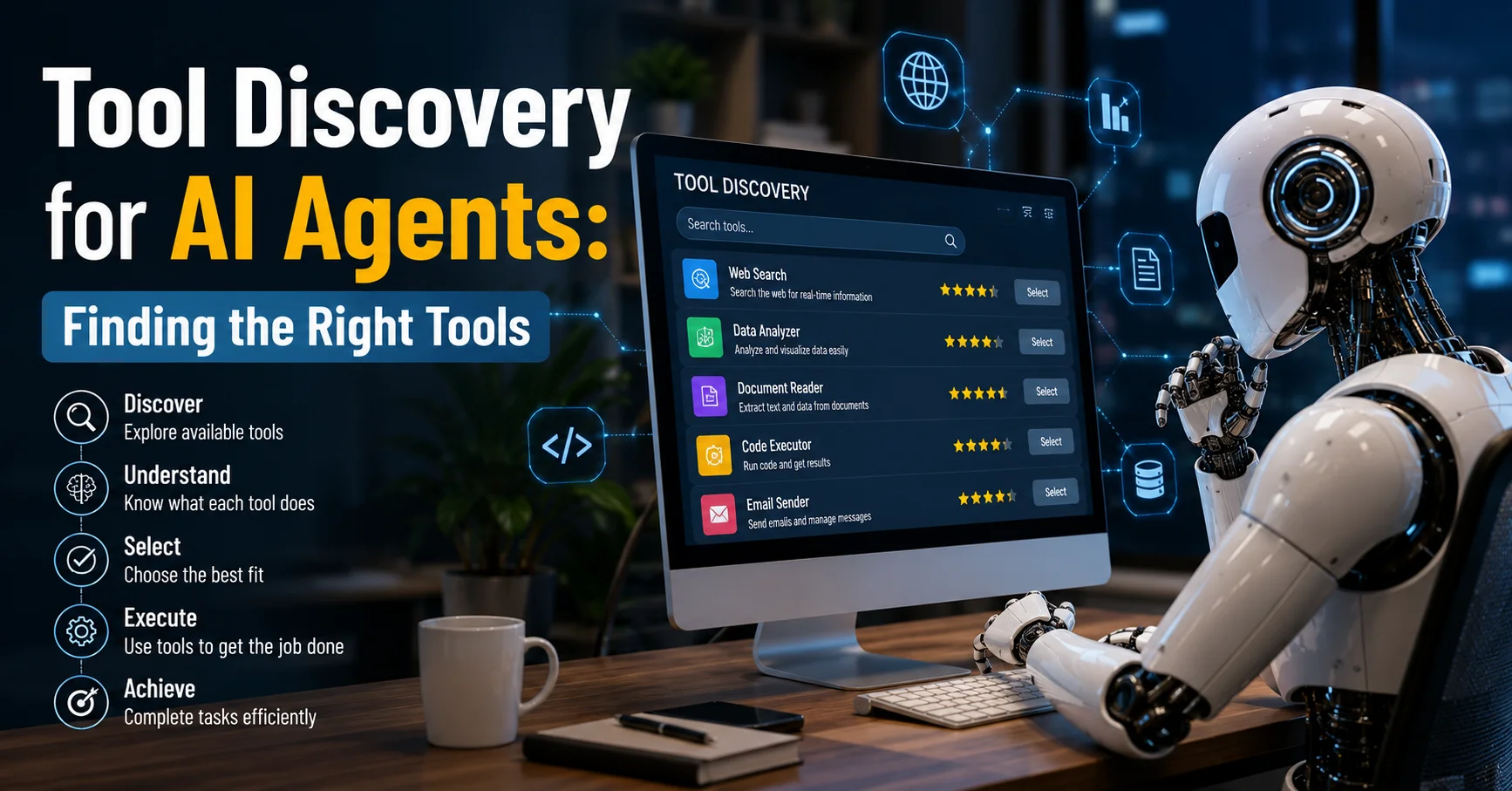
Tool Discovery For AI Agents are becoming much more capable, but intelligence alone is not enough. An agent may understand a question perfectly and still fail to complete a task if it does not have access to the right tools. Whether it needs to search a database, retrieve information, calculate a result, send a message, analyze a document, or interact with another application, the agent must first know which tool can help and how to use it.
This is where tool discovery for AI agents becomes important.
Tool Discovery For AI Agents is the process of helping an AI agent identify available tools, understand what those tools do, determine which one is appropriate for a particular task, and use it correctly. As AI systems gain access to hundreds or even thousands of tools, effective discovery is becoming a core part of building reliable agentic systems.
Instead of giving an agent every possible tool and hoping it chooses correctly, developers can create smarter discovery mechanisms that allow the agent to find the most relevant capabilities when needed.
ALSO READ: Google Domains Synthetic Records Explained Simply
What Is Tool Discovery For AI Agents?
Tool discovery for AI agents refers to the methods and systems used to help an AI agent find, understand, and select tools that can be used to accomplish a specific task.
A Tool Discovery For AI Agents can be almost anything that gives an AI agent an additional capability. For example, an agent might have access to:
- Web search tools
- Calculators
- Databases
- APIs
- File readers
- Code execution environments
- Calendar systems
- Email services
- Customer relationship management platforms
- Document-processing tools
- Image-generation systems
- Business intelligence platforms
The challenge is that an agent cannot simply use a Tool Discovery For AI Agents because it exists. It needs to understand what the tool does, what inputs it requires, what outputs it produces, and when it should be used.
Imagine asking an AI agent to find the total sales generated by a company during the previous month. The agent might have access to a database search tool, spreadsheet analyzer, calculator, and reporting API.
The correct workflow could be:
Understand the user’s request.
Determine what information is needed.
Discover the available sales-data tool.
Examine its capabilities and required parameters.
Select the appropriate tool.
Retrieve the relevant data.
Calculate or analyze the result.
Present the answer.
Without effective Tool Discovery For AI Agents, the agent may choose an inefficient tool, use the wrong API, or fail to complete the task entirely.
Why AI Agents Need Tool Discovery
Traditional software generally follows predefined instructions. Developers decide which function should run in a particular situation.
Tool Discovery For AI Agents are different.
They are often expected to operate dynamically. A user can ask for something unexpected, and the agent needs to determine how to accomplish it. This flexibility makes Tool Discovery For AI Agents extremely valuable.
Agents Can Access More Capabilities
An AI agent may interact with many different services. Giving the model a complete description of every available Tool Discovery For AI Agents can create unnecessary complexity.
Tool Discovery For AI Agents allows the agent to find relevant capabilities when they are actually needed.
For example, instead of presenting 200 tools to an agent every time it receives a request, a discovery system could identify five tools related to the user’s task.
This makes the environment easier to navigate.
It Reduces Unnecessary Tool Usage
More tools do not automatically make an AI agent better.
If an agent has too many choices, it can become difficult to determine which capability is appropriate. Tool discovery helps narrow the options.
A focused list of relevant tools can improve decision-making and reduce accidental or inefficient tool calls.
It Makes Agent Systems Easier to Scale
As an AI application grows, its number of tools may increase rapidly.
A small assistant might initially use:
- A search tool
- A calculator
- A database
Later, it may need:
- Payment systems
- CRM tools
- Analytics platforms
- File-processing services
- Communication tools
- Scheduling systems
- Internal company APIs
Manually managing every tool inside the agent’s permanent context becomes increasingly difficult.
A discovery layer provides a more scalable approach.
How Tool Discovery Works
Although implementations vary, the basic process usually follows a straightforward pattern.
Understand the Task
The agent first interprets what the user wants.
Suppose someone asks:
“Find our best-performing product this quarter and explain why it performed well.”
The agent needs more than simple text generation. It may need access to sales data, product information, and possibly analytics.
Identify Required Capabilities
The system determines what capabilities are necessary.
In this example, the agent might need:
- Sales-data retrieval
- Data analysis
- Product information
- Possibly market or customer data
Search the Tool Catalog
The discovery mechanism searches available tool descriptions.
It might look for tools associated with concepts such as:
- Sales
- Revenue
- Products
- Analytics
- Customer behavior
Rank Potential Tools
Several tools may appear relevant.
The agent or discovery system evaluates them according to factors such as:
- Functionality
- Input requirements
- Reliability
- Permissions
- Cost
- Availability
- Expected output
- Relevance to the task
Select the Best Tool
The most suitable tool is selected.
The agent then receives enough information to invoke that tool correctly.
Execute and Evaluate
After the tool produces a result, the agent evaluates whether the output actually answers the user’s request.
If necessary, it can discover another tool and continue the workflow.
This creates a dynamic cycle:
Understand → Discover → Select → Use → Evaluate → Continue
Tool Descriptions Matter More Than You Might Think
One of the most important parts of tool discovery is the quality of tool descriptions.
A vague description makes discovery difficult.
For example:
Gets information.
This does not tell an AI agent much.
A better description would explain:
Retrieves monthly sales transactions from the company’s internal sales database using a product ID, date range, and region.
The second description provides useful context about:
- What the tool does
- Where the data comes from
- What inputs it needs
- What type of task it supports
Clear descriptions improve the agent’s ability to identify the right capability.
What a Good Tool Description Should Include
A useful tool definition should generally explain:
- Tool name
- Purpose
- Supported tasks
- Required inputs
- Optional inputs
- Expected output
- Limitations
- Authentication requirements
- Potential errors
- Appropriate use cases
This information helps the agent make better decisions.
Tool Discovery vs. Tool Selection
Tool discovery and tool selection are related, but they are not exactly the same.
Tool discovery answers:
What tools are available that might help?
Tool selection answers:
Which of those tools should I actually use?
Consider an AI agent that needs to check the weather.
The discovery stage might find three weather-related tools:
- Current weather API
- Seven-day forecast API
- Historical weather database
The selection stage determines that the current weather API is the appropriate choice if the user asks, What’s the weather right now?
Separating these stages can make complex agent architectures easier to manage.
Common Approaches To Tool Discovery
There is no single method that works for every AI agent. Different systems use different discovery strategies.
Static Tool Lists
The simplest approach is to provide the agent with a fixed list of tools.
This works well when an application has only a few capabilities.
For example, a customer-support assistant might always have access to:
- Customer lookup
- Order lookup
- Refund processing
- Support ticket creation
The advantage is simplicity.
The downside is that static lists become harder to manage as the number of tools grows.
Search-Based Discovery
A more scalable approach is to create a searchable catalog of tools.
Instead of exposing every tool at once, the agent searches the catalog based on the user’s request.
For example, a request about scheduling could return:
- Calendar availability
- Meeting creation
- Appointment cancellation
- Reminder creation
This approach becomes particularly useful for large tool ecosystems.
Semantic Tool Discovery
Semantic search allows the system to discover tools based on meaning rather than exact keywords.
Suppose a tool is named customer_insights.
A user may ask:
Why are customers leaving our service?
The request does not necessarily contain the word “insights,” but semantic discovery can recognize that customer analysis may be relevant.
This makes tool discovery more flexible.
Hierarchical Discovery
Some large systems organize tools into categories.
For example:
Business Tools
- CRM
- Sales
- Accounting
Communication Tools
- Messaging
- Notifications
Data Tools
- Databases
- Analytics
- Reporting
The agent first identifies the appropriate category and then discovers a specific tool.
This can reduce the search space.
Challenges In Tool Discovery
Although tool discovery offers major benefits, it also introduces several challenges.
Too Many Similar Tools
An agent may discover multiple tools that appear to perform the same function.
For example, a system could contain three different search APIs.
The agent needs enough information to understand their differences.
Descriptions should clearly communicate when each tool is preferred.
Poor Tool Metadata
Incomplete metadata makes discovery unreliable.
If a tool does not specify required inputs, limitations, or output formats, the agent may attempt to use it incorrectly.
Tool Naming Problems
Tool names should be descriptive and consistent.
Names such as:
tool_1process_datarun_task
are difficult for both humans and AI systems to interpret.
A name such as search_customer_orders immediately communicates its purpose.
Security and Permissions
Not every tool should be available to every agent.
An AI assistant might be allowed to read customer information but not delete customer records.
Tool discovery should therefore consider permissions.
The discovery system should not expose sensitive capabilities simply because they exist.
Cost and Performance
Some tools may be expensive or slow.
For example, an AI agent might have access to several data-processing services. One may return results in seconds, while another takes several minutes and costs considerably more.
The discovery process should account for these differences when appropriate.
Improving Tool Discovery For AI Agents
A reliable tool-discovery system requires more than simply storing tool descriptions.
Here are several practical strategies.
Use Clear and Specific Metadata
Every tool should have a concise but informative description.
Avoid unnecessary technical language while still explaining the tool’s purpose and limitations.
Include Examples
Examples can make tool capabilities easier for an AI model to understand.
For instance, a database tool description could include example requests such as:
- Find all orders from July.
- Retrieve sales for product X.
- Compare regional revenue.
Examples provide practical context.
Define Input Requirements Clearly
The agent needs to know exactly what information a tool requires.
If a tool expects:
- Customer ID
- Start date
- End date
the definition should say so clearly.
Ambiguous parameters often lead to failed calls.
Explain When Not to Use a Tool
This is an overlooked but valuable technique.
A tool description can explain situations where the capability should not be selected.
For example:
Use this tool for historical sales data. Do not use it for real-time inventory.
Negative guidance can help distinguish similar tools.
Add Reliability Information
If several tools provide similar functionality, reliability can influence selection.
Useful metadata may include:
- Availability
- Typical response time
- Rate limits
- Data freshness
- Error frequency
This information can help the agent choose more intelligently.
The Role Of Context In Tool Discovery
Tool discovery should always consider context.
The same tool can be useful for one task and completely irrelevant for another.
Suppose an AI agent has access to a calculator, financial database, and spreadsheet tool.
If the user asks:
What is 48 multiplied by 27?
The calculator is the obvious choice.
If the user asks:
Analyze our quarterly financial performance.
The financial database and spreadsheet tools may be more appropriate.
Context allows the agent to distinguish between simple and complex requirements.
Tool Discovery And Multi-Agent Systems
Tool discovery becomes even more interesting in multi-agent systems.
Instead of one agent doing everything, different agents may specialize in particular tasks.
For example:
- Research agent
- Data-analysis agent
- Customer-support agent
- Planning agent
- Coding agent
Each agent may have access to different tools.
A central discovery mechanism can help agents locate capabilities outside their immediate environment.
For instance, a research agent might discover that a data-analysis agent can process a large dataset.
The research agent can then delegate that part of the task rather than attempting to handle everything itself.
This can create more efficient and specialized AI workflows.
Dynamic Tool Discovery And Agent Autonomy
One major advantage of dynamic discovery is increased autonomy.
An agent does not need to be explicitly programmed for every possible situation.
Instead, it can determine:
What needs to be accomplished.
What capabilities are required.
Which tools provide those capabilities.
How those tools should be combined.
This is one of the characteristics that makes agentic AI different from traditional chatbot systems.
However, autonomy should not mean unrestricted access.
A well-designed system balances flexibility with control.
Security Should Be Part Of Tool Discovery
Security cannot be treated as an afterthought.
If an AI agent can discover tools dynamically, the discovery system must ensure that it only sees tools it is authorized to use.
Important considerations include:
Authentication
Tools should require appropriate credentials where necessary.
Authorization
Agents should have clearly defined permissions.
Data Access
Sensitive information should only be exposed when the agent has a legitimate reason and appropriate authorization.
Action Restrictions
High-impact operations such as deleting records, transferring money, or modifying important systems should receive additional controls.
Audit Logs
Organizations should be able to determine which agent discovered and used a particular tool and why.
These controls help make autonomous systems safer and easier to monitor.
Evaluating Whether Tool Discovery Is Working
Building a tool-discovery system is only the beginning. Its performance should be measured.
Useful metrics include:
Discovery accuracy: How often does the system identify a relevant tool?
Selection accuracy: How often does the agent choose the best available option?
Tool-call success rate: How often does the selected tool execute successfully?
Task completion rate: How often does the entire workflow achieve the user’s objective?
Latency: How long does discovery take?
Cost: How much does tool discovery and execution contribute to the overall system cost?
These measurements can reveal where improvements are needed.
A Practical Example Of Tool Discovery
Consider an AI assistant used by an online retailer.
A customer asks:
Can you tell me when my latest order will arrive?
The agent first understands that it needs order information and shipment tracking.
The discovery system searches for relevant capabilities and finds:
- Customer-order lookup
- Shipment tracking
- Product catalog
- Refund processing
The agent determines that product catalog information is unnecessary.
It first uses the order lookup tool to identify the latest order. Then it uses the shipment tracking tool to retrieve the estimated delivery date.
Finally, it explains the result to the customer.
The important part is that the agent did not need to use every available tool. It discovered the capabilities relevant to the task and created a focused workflow.
Best Practices For Building A Tool Discovery System
If you are developing an AI agent, several practices can make tool discovery more effective.
Keep Tool Definitions Simple
AI agents should not have to interpret unnecessarily complicated descriptions.
Use Consistent Naming
Follow a predictable naming convention across your tools.
Organize Related Tools
Categories make large tool collections easier to navigate.
Provide Useful Examples
Examples help agents understand intended usage.
Include Limitations
Tell the agent what the tool cannot do.
Apply Permissions Early
Do not expose unauthorized tools during discovery.
Monitor Tool Selection
Review which tools agents select and identify recurring mistakes.
Improve Descriptions Over Time
Tool metadata should evolve based on real-world usage.
Avoid Redundant Tools
If several tools perform nearly identical functions, consider whether all of them are necessary.
A smaller, well-organized tool ecosystem can often be more effective than a huge collection of poorly differentiated capabilities.
The Future Of Tool Discovery For AI Agents
As AI agents become more common, tool discovery is likely to become an increasingly important part of agent architecture.
Future systems may contain enormous ecosystems of specialized capabilities. Agents could discover tools dynamically based on the user’s goal, available permissions, cost constraints, expected performance, and previous experience.
Instead of thinking about AI as a model with a fixed collection of functions, it may be more useful to think about AI agents as systems capable of navigating a constantly changing capability environment.
An agent might encounter a new task, search for suitable capabilities, evaluate available options, use the best tool, and learn from the outcome.
This could make AI systems considerably more flexible.
At the same time, better discovery will need better governance. Organizations will need strong permission systems, monitoring, clear tool definitions, and reliable evaluation methods.
The goal is not simply to give agents more tools.
The goal is to help them find the right tool at the right time and use it correctly.
Conclusion
Tool discovery for AI agents is becoming a fundamental part of building useful and scalable agentic systems. As agents gain access to more APIs, databases, applications, and specialized services, simply providing a large list of tools is no longer enough.
Effective discovery helps an agent understand what capabilities exist, identify which ones are relevant, compare available options, and select the appropriate tool for the task.
The strongest systems combine clear tool descriptions, semantic search, contextual reasoning, permission controls, performance information, and continuous evaluation. They make tools easier for AI agents to understand while keeping access controlled and purposeful.
Ultimately, successful AI agents are not defined only by how well they can generate text or reason through a problem. Their real value often comes from what they can accomplish. Finding the right tools is a crucial step between knowing what to do and actually getting it done.
FAQs
What is tool discovery for AI agents?
Tool discovery for AI agents is the process of finding and identifying the tools an AI agent needs to complete a specific task.
Why is tool discovery important?
It helps agents choose relevant capabilities without having to rely on a large, confusing list of available tools.
How do AI agents discover tools?
Agents can discover tools through searchable catalogs, semantic search, structured metadata, categories, and contextual matching.
What makes a good AI tool description?
A good description clearly explains the tool’s purpose, inputs, outputs, use cases, limitations, and important requirements.
Can tool discovery improve AI agent performance?
Yes. Effective discovery can help reduce incorrect tool calls, improve task completion, lower unnecessary usage, and make agent workflows more efficient.
ALSO READ: ETL Process Optimization: Smarter Data Workflows

Emily Carter is a tech enthusiast who writes about PC cooling, hardware performance, and system optimization. She enjoys simplifying complex topics and helping readers make better tech decisions.