
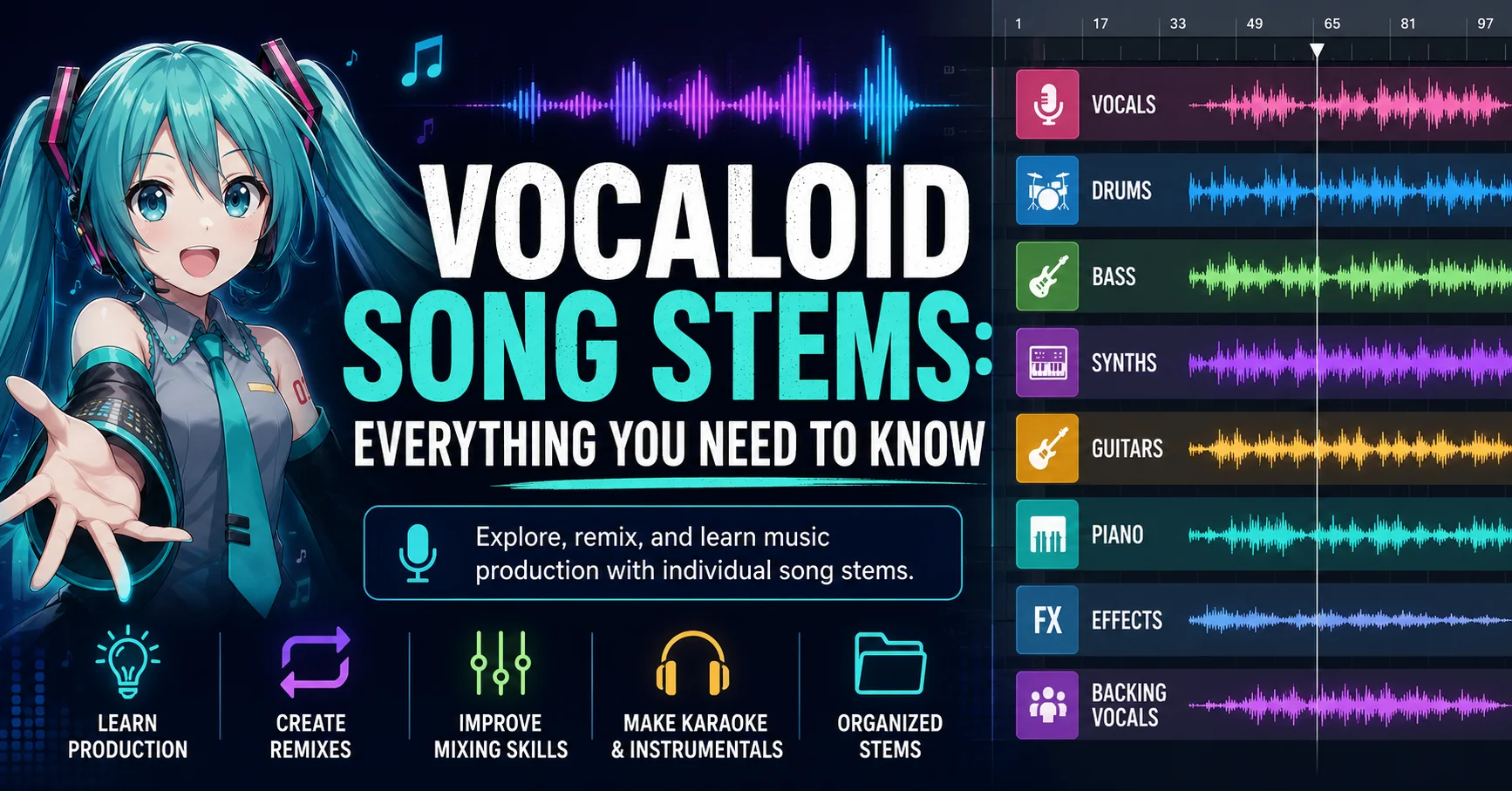
If you’ve ever wanted to remix a Vocaloid song, study how your favorite producer created a hit, or improve your own music production skills, you’ve probably come across the term Vocaloid song stems. These individual audio tracks allow producers, remix artists, DJs, and fans to work with separate parts of a song instead of a single mixed file.
Whether you’re new to music production or an experienced creator, understanding Vocaloid song stems can open up exciting creative possibilities. They make it easier to remix songs, create mashups, practice mixing techniques, and even learn professional production workflows.
you’ll discover what Vocaloid song stems are, how they differ from multitracks, where they come from, how they’re used, and what you should know before downloading or sharing them.
ALSO READ: Free Kanye Kits: Complete Download Guide
What Are Vocaloid Song Stems?
Vocaloid song stems are separate audio files that contain specific groups of sounds from a Vocaloid song. Instead of receiving one finished audio track, you get multiple files representing different elements of the mix.
A typical set of stems might include:
- Vocal track
- Drums
- Bass
- Synths
- Piano
- Guitar
- Sound effects
- Background vocals
- Strings
- Additional instruments
When these stems are played together at the same starting point, they recreate the complete song exactly as it was mixed.
This allows producers to adjust, remix, replace, or process individual parts without affecting the rest of the music.
How Do Vocaloid Song Stems Work?
Every modern digital song is built from dozens—or sometimes hundreds—of recorded tracks.
During production, the creator combines similar sounds into grouped files called stems.
For example:
- All drum sounds become one stem.
- All lead vocals become another.
- Background instruments may be grouped together.
- Electronic effects become their own track.
Instead of editing hundreds of channels, remix artists can work with a manageable collection of audio files.
Difference Between Stems And Multitracks
Many beginners confuse stems with multitracks, but they are different.
Vocaloid Song Stems
- Grouped audio tracks
- Easier to manage
- Smaller file size
- Ideal for remixing
- Commonly shared by artists
Multitracks
- Every recorded channel separately
- Much larger projects
- Used during professional mixing
- Greater editing flexibility
- Usually remain private
Think of stems as simplified versions of an entire production project.
Why Are Vocaloid Song Stems Popular?
There are several reasons producers and fans actively search for Vocaloid song stems.
Learning Music Production
Studying professional stems helps producers understand:
- Instrument balance
- Vocal processing
- Equalization
- Compression
- Reverb usage
- Stereo placement
Listening to isolated tracks reveals details that are hidden in the final mix.
Creating Remixes
Many remix competitions require official stems.
Producers can:
- Change genres
- Add new instruments
- Rearrange sections
- Build dance versions
- Create lo-fi edits
- Produce orchestral remakes
The original vocals remain perfectly synchronized with the music.
Practicing Mixing Skills
Students learning audio engineering often practice using stems.
Exercises include:
- Volume balancing
- Panning
- Compression
- Equalization
- Automation
- Mastering preparation
Since every element is separated, it’s easier to hear improvements.
Karaoke and Instrumentals
Removing vocals from a finished song often creates noticeable artifacts.
Using official stems allows creators to produce:
- Clean karaoke versions
- Instrumentals
- Vocal-only versions
- Practice tracks
The result sounds far more professional.
Who Uses Vocaloid Song Stems?
Many different creators benefit from stems.
Music Producers
They create remixes, alternate mixes, and genre transformations.
DJs
Stems allow DJs to perform live mashups and transitions.
Content Creators
Video creators use instrumental stems for background music.
Musicians
Instrumentalists practice alongside isolated vocals or backing tracks.
Audio Students
Students analyze production techniques from experienced Vocaloid producers.
Common Components Found In Vocaloid Song Stems
Depending on the project, stems may include:
Lead Vocal Stem
Contains the synthesized Vocaloid singing.
Harmony Stem
Extra vocal layers that support the melody.
Drum Stem
Includes kick, snare, hi-hats, percussion, and cymbals.
Bass Stem
Contains electric, synth, or sampled bass sounds.
Synth Stem
Pads, leads, arpeggiators, and electronic textures.
Guitar Stem
Electric or acoustic guitars.
Piano Stem
Solo piano or layered keyboard parts.
FX Stem
Risers, impacts, transitions, ambience, and special effects.
Benefits Of Using Vocaloid Song Stems
Working with stems offers several advantages.
Better Learning Experience
You hear each instrument individually.
Faster Editing
Only modify the part you need.
Cleaner Remixes
No unwanted frequencies from other instruments.
Higher Audio Quality
Official stems retain studio-quality sound.
Greater Creative Freedom
Experiment with countless production styles.
Challenges Of Working With Stems
Although stems are useful, they also present some challenges.
Limited Availability
Many Vocaloid producers never release official stems.
Large File Sizes
High-quality WAV stems require significant storage space.
Synchronization
All files must begin at exactly the same point.
Processing Differences
Some stems already contain effects like compression and reverb, limiting editing options.
Audio Formats Used For Vocaloid Song Stems
Professional stems are usually delivered in:
WAV
The industry standard.
Advantages:
- Lossless quality
- Excellent for production
- High dynamic range
AIFF
Common among Mac users.
FLAC
Compressed without losing audio quality.
MP3
Occasionally used but not ideal because compression reduces quality.
Tips For Mixing Vocaloid Song Stems
If you’re working with stems, these practices can improve your results.
Keep Original Timing
Avoid shifting stems accidentally.
Organize Tracks
Label each stem clearly before editing.
Use Reference Mixes
Compare your mix with the original release.
Avoid Excessive Processing
Small adjustments often produce better results than dramatic changes.
Leave Headroom
Prevent clipping by maintaining enough volume space during mixing.
Can Beginners Use Vocaloid Song Stems?
Absolutely.
Beginners often improve more quickly by working with professional stems instead of recording everything themselves.
They can learn:
- Song structure
- Mixing techniques
- Arrangement
- Dynamics
- Automation
- Mastering preparation
Hands-on practice provides valuable experience.
Legal Considerations
Before using Vocaloid song stems, it’s important to understand licensing.
Some stems are officially released for:
- Remix contests
- Educational purposes
- Personal learning
Others remain copyrighted.
Before publishing remixes commercially or distributing stems, always check the creator’s license or permission terms. Respecting copyright helps support original artists and producers.
How To Organize Vocaloid Song Stems
Keeping projects organized saves time later.
A simple folder structure might include:
- Vocals
- Drums
- Bass
- Instruments
- Effects
- Mix Exports
- Project Files
Clear naming makes collaboration much easier.
Best Software For Working With Vocaloid Song Stems
Most Digital Audio Workstations (DAWs) support stems.
Popular options include:
- Ableton Live
- FL Studio
- Cubase
- Studio One
- Logic Pro
- REAPER
- Pro Tools
These programs allow you to import, edit, mix, and export stems efficiently.
Common Mistakes To Avoid
Many beginners make similar mistakes.
Avoid these habits:
- Over-compressing vocals
- Boosting every frequency
- Ignoring gain staging
- Adding too much reverb
- Forgetting to save project versions
- Mixing at excessive volume
- Using low-quality exported files
A balanced workflow usually produces cleaner results.
How Vocaloid Song Stems Help Improve Creativity
Stems encourage experimentation.
You can:
- Replace instruments
- Change tempos
- Build acoustic versions
- Create orchestral arrangements
- Produce EDM remixes
- Add live instruments
- Learn professional production techniques
Every project becomes an opportunity to develop new skills.
Future Of Vocaloid Song Stems
As music production tools continue evolving, stems are becoming increasingly valuable.
Modern software now supports faster stem editing, AI-assisted separation, and advanced remix workflows. More producers are also exploring collaborative projects where stems make it easier for musicians worldwide to contribute new ideas.
For Vocaloid creators, stems will likely remain an important part of remix culture, fan creativity, educational content, and professional music production.
Conclusion
Vocaloid song stems provide a powerful way to explore, remix, and better understand music production. By separating a song into its key components, they give producers, students, DJs, and musicians the flexibility to work on individual elements while preserving the integrity of the original composition.
Whether your goal is to improve your mixing skills, create exciting remixes, analyze professional production techniques, or experiment with new arrangements, working with stems offers countless creative opportunities. As long as you respect licensing terms and organize your workflow effectively, Vocaloid song stems can become one of the most valuable resources in your music production journey.
FAQs
What is Vocaloid song stems?
Vocaloid song stems are separate audio files containing grouped elements of a Vocaloid song, such as vocals, drums, bass, and instruments, allowing easier remixing and music production.
Are Vocaloid song stems the same as multitracks?
No. Stems combine similar audio tracks into groups, while multitracks contain every individual recorded channel.
Can beginners learn music production using Vocaloid song stems?
Yes. Stems are excellent learning tools for practicing mixing, arrangement, and audio editing techniques.
What file format is best for Vocaloid song stems?
WAV is generally the preferred format because it preserves full audio quality without compression.
Can I use Vocaloid song stems for commercial projects?
Only if the copyright holder or license specifically allows commercial use. Always review the licensing terms before publishing or selling any remix.
ALSO READ: Machikado Mazoku Transformations You Should Know

Emily Carter is a tech enthusiast who writes about PC cooling, hardware performance, and system optimization. She enjoys simplifying complex topics and helping readers make better tech decisions.