
When learning advanced C++ programming techniques, developers often come across the term static dispatch C with CRTP. At first glance, it can sound complicated and intimidating, especially for beginners. However, once you understand the concept behind it, you’ll discover that it is a powerful technique that can improve performance, reduce runtime overhead, and help create flexible code structures.
Traditional object-oriented programming frequently relies on virtual functions and dynamic dispatch. While this approach offers flexibility, it also introduces some runtime costs. The Curiously Recurring Template Pattern (CRTP) provides an alternative by enabling compile-time polymorphism, often referred to as Static Dispatch C With CRTP.
we will explore what Static Dispatch C With CRTP works, why developers use it, and how it can help you write more efficient C++ code. By the end of this article, you’ll have a solid understanding of Static Dispatch C With CRTP and know when it makes sense to use it in your own projects.
ALSO READ: Embroidery File Types Explained: A Simple Guide For Beginners
Understanding Static Dispatch C With CRTP In C++
Before diving into CRTP, it’s important to understand what dispatch means.
Dispatch refers to the process of determining which function implementation should be executed when a function is called.
There are two primary types:
Dynamic Dispatch
Dynamic dispatch happens at runtime.
This usually involves virtual functions.
class Base {
public:
    virtual void show() {
        std::cout << "Base" << std::endl;
    }
};

class Derived : public Base {
public:
    void show() override {
        std::cout << "Derived" << std::endl;
    }
};
Here, the compiler determines the actual function to call during program execution.
Static Dispatch
Static Dispatch C With CRTP happens during compilation.
The compiler already knows which function should be called and generates the appropriate code directly.
This eliminates the need for virtual tables and runtime lookups.
As a result, Static Dispatch C With CRTP is often faster and more optimized.
What Is CRTP?
CRTP stands for Curiously Recurring Template Pattern.
It is a C++ design pattern where a class inherits from a template instantiation of itself.
The syntax may look unusual at first:
template <typename Derived>
class Base {
};

class Child : public Base<Child> {
};
Notice how the derived class passes itself as the template argument to the base class.
This self-referencing structure is what makes CRTP unique.
The pattern allows the base class to access functionality provided by the derived class at compile time.
Why Use Static Dispatch With CRTP?
The primary reason developers use Static Dispatch C With CRTP is performance.
Because all function calls are resolved during compilation, the compiler can:
- Eliminate virtual function overhead
- Inline functions more effectively
- Produce faster executable code
- Enable better optimization opportunities
In performance-critical applications such as game engines, numerical simulations, embedded systems, and real-time software, these advantages can be significant.
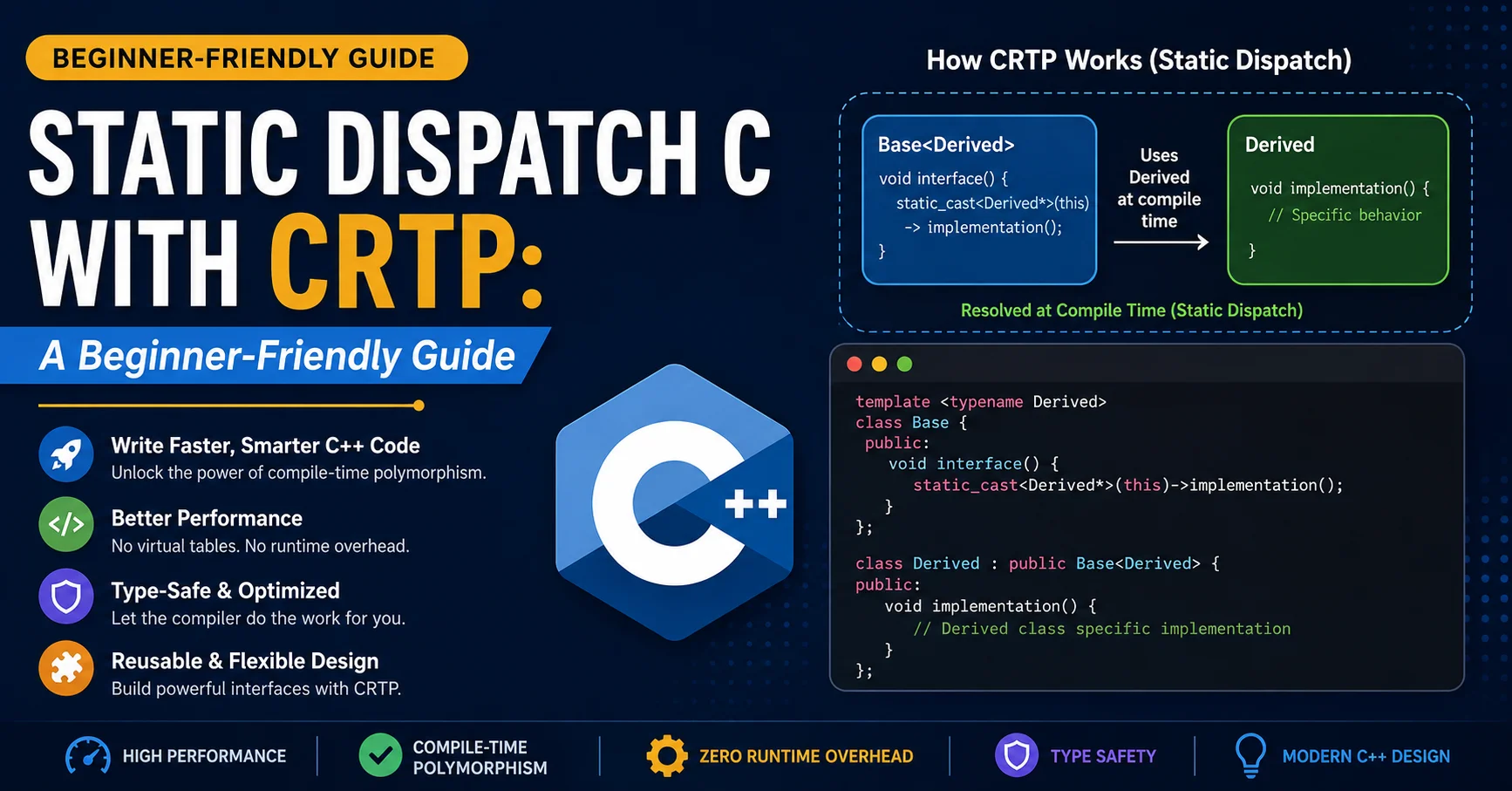
How Static Dispatch C With CRTP
Let’s look at a simple example.
#include <iostream>

template <typename Derived>
class Base {
public:
    void interface() {
        static_cast<Derived*>(this)->implementation();
    }
};

class Derived : public Base<Derived> {
public:
    void implementation() {
        std::cout << "Derived implementation" << std::endl;
    }
};

int main() {
    Derived obj;
    obj.interface();
}
How It Works
The Derived class inherits from Base<Derived>.
The base class uses:
static_cast<Derived*>(this)
to access the derived class.
The compiler knows exactly which implementation will be called.
No virtual functions are required.
The result is static polymorphism with zero runtime dispatch cost.
Static Polymorphism vs Dynamic Polymorphism
Understanding the difference between these concepts helps clarify why CRTP is valuable.
Dynamic Polymorphism
Advantages:
- Flexible runtime behavior
- Supports runtime object substitution
- Easy to understand
Disadvantages:
- Virtual function overhead
- Extra memory for virtual tables
- Less compiler optimization
Static Polymorphism
Advantages:
- Faster execution
- No virtual table
- Better optimization opportunities
- Compile-time checking
Disadvantages:
- Less runtime flexibility
- More complex template syntax
- Increased compilation time
The choice depends on your project’s requirements.
A Real-World Example
Suppose you’re creating a logging framework.
Instead of using virtual functions, you can use CRTP.
template <typename Derived>
class Logger {
public:
    void log() {
        static_cast<Derived*>(this)->writeLog();
    }
};

class FileLogger : public Logger<FileLogger> {
public:
    void writeLog() {
        std::cout << "Writing to file" << std::endl;
    }
};

class ConsoleLogger : public Logger<ConsoleLogger> {
public:
    void writeLog() {
        std::cout << "Writing to console" << std::endl;
    }
};
Usage:
FileLogger file;
ConsoleLogger console;

file.log();
console.log();
The compiler generates direct function calls without any virtual dispatch.
Benefits Of Static Dispatch C With CRTP
Improved Performance
One of the biggest advantages is speed.
Since function resolution occurs at compile time, execution becomes more efficient.
Better Compiler Optimization
Compilers can aggressively optimize CRTP-based code.
This often leads to:
- Function inlining
- Dead code elimination
- Reduced instruction counts
No Virtual Function Overhead
Virtual functions require runtime lookup through a virtual table.
CRTP removes this overhead entirely.
Type Safety
Many errors are caught during compilation rather than at runtime.
This makes applications more reliable.
Reusable Code
The base template can contain shared functionality while still leveraging behavior from derived classes.
Common CRTP Pattern Example
A popular use of CRTP is implementing reusable interfaces.
template <typename Derived>
class Printable {
public:
    void print() {
        static_cast<Derived*>(this)->printImpl();
    }
};
Derived class:
class Document : public Printable<Document> {
public:
    void printImpl() {
        std::cout << "Printing document" << std::endl;
    }
};
This creates a consistent interface while maintaining compile-time efficiency.
CRTP And Compile-Time Polymorphism
Compile-time polymorphism means the behavior is selected before the program runs.
Examples include:
- Function overloading
- Template specialization
- CRTP
Unlike virtual functions, which defer decisions until runtime, compile-time polymorphism resolves everything during compilation.
This often produces faster executables.
Limitations Of Static Dispatch C With CRTP
Although powerful, CRTP is not perfect.
More Complex Syntax
Many beginners find the pattern confusing initially.
The self-referencing template structure can look unusual.
Less Runtime Flexibility
CRTP cannot easily replace runtime polymorphism.
For example:
Base* ptr = new Derived();
This common dynamic polymorphism pattern does not work the same way with CRTP.
Code Bloat
Templates can generate multiple copies of code.
Large projects using extensive templates may see increased binary sizes.
Longer Compile Times
Heavy template usage often increases compilation duration.
When Should You Use CRTP?
CRTP is ideal when:
- Performance is critical
- Behavior is known at compile time
- Runtime polymorphism isn’t required
- You want reusable compile-time interfaces
- You’re building libraries or frameworks
Examples include:
- Game engines
- Mathematical libraries
- Embedded systems
- High-performance computing
- Expression template libraries
When Should You Avoid CRTP?
CRTP may not be the best choice when:
- Runtime flexibility is essential
- Plugin architectures are required
- Object types are unknown until execution
- Simplicity is more important than optimization
In these situations, traditional inheritance and virtual functions may be more suitable.
Best Practices For Using Static Dispatch C With CRTP
Keep the Base Class Lightweight
Avoid placing unnecessary logic in the CRTP base class.
Document Your Design
Many developers are unfamiliar with CRTP.
Clear comments improve maintainability.
Use Meaningful Names
Names like:
Derived
Implementation
ConcreteType
help communicate intent.
Avoid Excessive Nesting
Complex template hierarchies become difficult to maintain.
Profile Before Optimizing
Only use CRTP when performance gains justify the added complexity.
Advanced Uses Of CRTP
Experienced developers often use CRTP for:
Mixins
Adding reusable functionality to classes.
Static Interfaces
Creating compile-time contracts.
Expression Templates
Improving performance in mathematical libraries.
Fluent APIs
Building efficient method-chaining systems.
Policy-Based Design
Separating behavior into configurable template policies.
These advanced techniques appear frequently in high-performance C++ libraries.
Comparing Virtual Functions And CRTP
| Feature | Virtual Functions | CRTP |
|---|---|---|
| Dispatch Time | Runtime | Compile Time |
| Performance | Moderate | High |
| Flexibility | High | Lower |
| Virtual Table | Required | Not Required |
| Compiler Optimization | Limited | Extensive |
| Runtime Polymorphism | Yes | No |
| Complexity | Lower | Higher |
This comparison highlights why CRTP is often chosen for performance-sensitive applications.
Conclusion
Static dispatch C with CRTP is a powerful C++ technique that enables compile-time polymorphism without the overhead of virtual functions. By allowing a derived class to pass itself as a template argument to its base class, CRTP gives the compiler enough information to resolve function calls during compilation.
For developers focused on performance, efficiency, and advanced template programming, CRTP can be an excellent tool. It reduces runtime costs, enables aggressive compiler optimizations, and creates reusable code structures. However, it also introduces additional complexity and sacrifices some runtime flexibility.
As a beginner, the best way to understand CRTP is through experimentation. Start with simple examples, observe how compile-time dispatch works, and gradually explore more advanced patterns. With practice, you’ll gain a deeper appreciation for why static dispatch with CRTP remains one of the most respected techniques in modern C++ development.
FAQs
What is static dispatch C with CRTP?
Static dispatch C with CRTP is a C++ technique that uses the Curiously Recurring Template Pattern to achieve compile-time polymorphism without virtual functions.
Why is CRTP faster than virtual functions?
CRTP resolves function calls at compile time, eliminating virtual table lookups and reducing runtime overhead.
Does CRTP replace inheritance?
No. CRTP uses inheritance but applies it differently to achieve static polymorphism.
Where is CRTP commonly used?
CRTP is commonly used in game engines, embedded systems, numerical libraries, and performance-critical applications.
Is CRTP suitable for beginners?
Yes. While the syntax may seem unusual initially, beginners can learn CRTP by starting with simple examples and gradually exploring advanced use cases.
ALSO READ: You Attract What You Are: Transform Your Mindset

Emily Carter is a tech enthusiast who writes about PC cooling, hardware performance, and system optimization. She enjoys simplifying complex topics and helping readers make better tech decisions.