Data is everywhere. Businesses collect information from websites, applications, customer interactions, sales systems, financial platforms, sensors, and countless other sources. But collecting data is only the beginning. The real challenge is turning that scattered information into something accurate, useful, and ready for analysis.
ETL, which stands for Extract, Transform, Load, is a fundamental process used to move data from different sources into a centralized destination where it can be analyzed and used for decision-making. However, a poorly designed ETL workflow can become slow, expensive, difficult to maintain, and frustrating for data teams.
That is why ETL process optimization has become increasingly important.
ETL Process Optimization is not simply about making data move faster. It is about creating smarter workflows that use resources efficiently, reduce unnecessary processing, improve data quality, and make information available when people need it.
we will explore what ETL Process Optimization means, why it matters, common performance problems, practical optimization techniques, and how businesses can build more reliable and efficient data workflows.
ALSO READ: Stall Mattress Horse: A Simple Guide For Better Comfort
What Is ETL Process Optimization?
ETL process optimization is the practice of improving an ETL workflow so that data can be extracted, transformed, and loaded more efficiently.
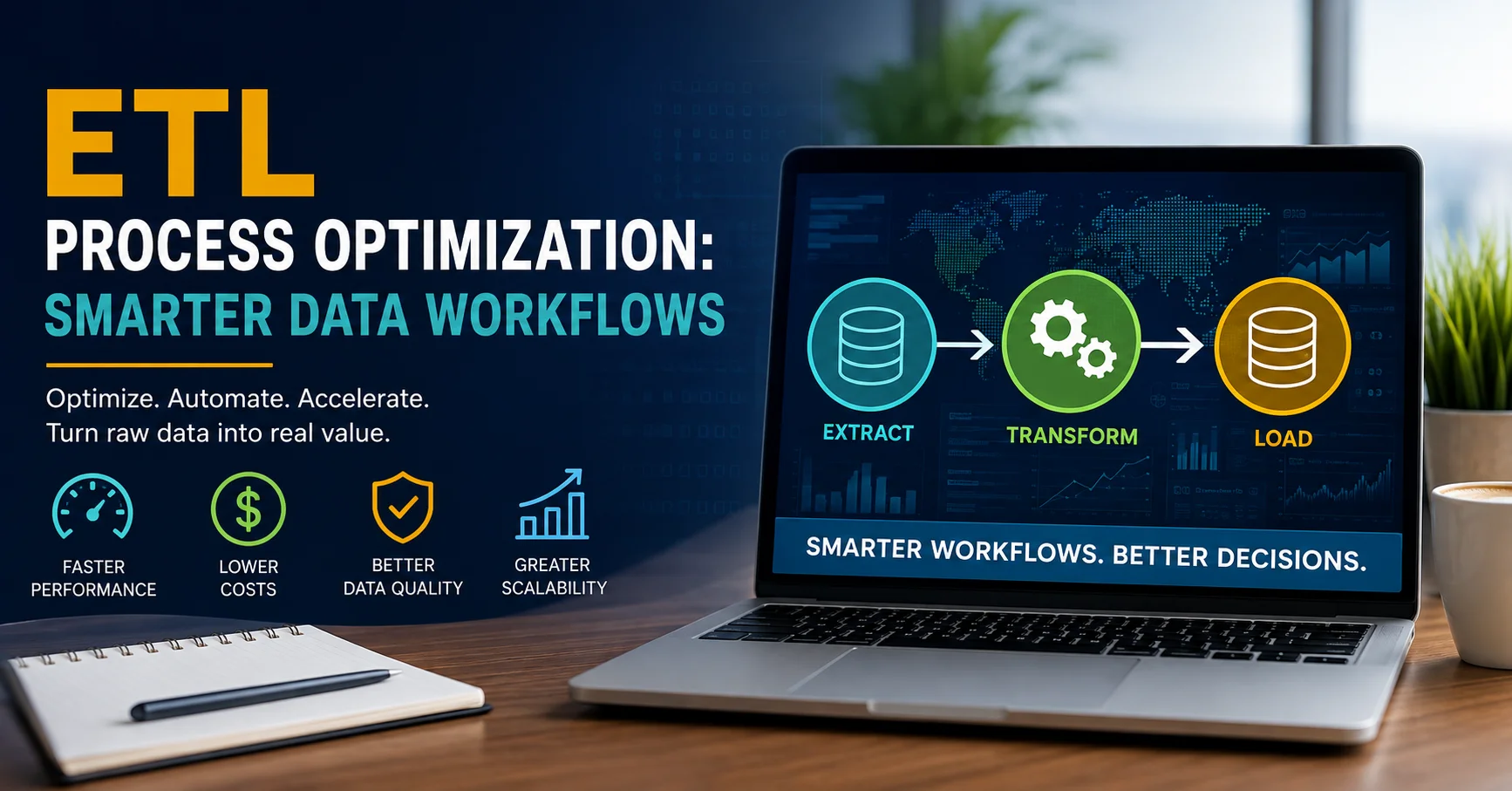
A traditional ETL pipeline generally includes three major stages:
- Extract: Data is collected from one or more sources.
- Transform: Raw data is cleaned, formatted, validated, combined, or modified.
- Load: Processed data is transferred into a target system such as a data warehouse or analytical database.
Optimization focuses on improving each of these stages.
For example, an inefficient ETL pipeline might extract an entire database every night even though only a few hundred records changed. A better approach would identify and process only the new or modified records.
Similarly, a transformation process may repeatedly perform expensive calculations that could be completed once and reused. Optimizing the workflow can eliminate unnecessary work and significantly reduce processing time.
The goal is simple: move the right data, perform the right transformations, and load it into the right destination with as little unnecessary work as possible.
Why ETL Process Optimization Matters
As data volumes grow, inefficient workflows become increasingly expensive.
A pipeline that works perfectly with one million records may struggle when the organization begins processing hundreds of millions of records. Small inefficiencies can multiply into major performance problems.
Effective optimization can provide several benefits.
Faster Data Processing
Optimized pipelines can process information more quickly, allowing reports, dashboards, and analytical systems to receive fresh data sooner.
For organizations that depend on near-real-time or frequent reporting, this can make a major difference.
Lower Infrastructure Costs
ETL workloads consume computing power, memory, storage, network bandwidth, and database resources.
When a pipeline performs unnecessary operations, the organization may end up paying for resources it does not actually need. Reducing redundant processing can lower infrastructure costs.
Better Data Quality
Optimization is not only about speed. A well-designed workflow can include better validation, error handling, duplicate detection, and consistency checks.
The result is data that users can trust.
Greater Scalability
A scalable ETL workflow should be able to handle increasing data volumes without requiring a complete redesign every time the business grows.
Optimization techniques such as incremental processing and parallel execution can help pipelines handle larger workloads more effectively.
Easier Maintenance
Complicated ETL workflows can become difficult to troubleshoot. Simplifying transformations, organizing dependencies, and monitoring individual pipeline stages makes maintenance easier for data engineers.
Understanding The Three Stages Of ETL Process Optimization
Before optimizing a workflow, it helps to understand where bottlenecks can occur.
The Extract Stage
Extraction is the process of retrieving data from source systems.
Sources might include:
- Relational databases
- APIs
- Cloud applications
- CSV files
- Log files
- Enterprise applications
- IoT systems
- Customer platforms
Extraction can become a bottleneck when the system retrieves too much data or repeatedly queries source systems unnecessarily.
For example, extracting a complete customer table containing 50 million records every hour is rarely efficient if only a small percentage of those records changes.
The Transform Stage
Transformation is where raw information becomes usable data.
Common transformations include:
- Removing duplicates
- Correcting formatting
- Standardizing values
- Converting data types
- Joining datasets
- Filtering records
- Calculating metrics
- Validating fields
- Applying business rules
Transformation is often one of the most computationally demanding parts of an ETL workflow.
Poorly designed joins, repeated calculations, inefficient queries, and unnecessary data movement can dramatically increase processing time.
The Load Stage
The final stage moves transformed information into its destination.
The destination might be a data warehouse, database, data lake, or another analytical system.
Loading large numbers of individual records can be inefficient. Batch loading, bulk operations, partitioning, and optimized insert strategies can often improve performance.
Common ETL Performance Problems
Before changing a pipeline, it is important to understand what is actually slowing it down.
One common mistake is optimizing based on assumptions rather than measurements.
Full Data Extraction
Full extraction means retrieving all available records during every pipeline run.
Although straightforward, it becomes increasingly inefficient as datasets grow.
If a table contains 100 million records and only 50,000 changed since the last run, processing all 100 million records creates unnecessary work.
Excessive Data Movement
Moving data between multiple systems requires network bandwidth and processing resources.
A pipeline that constantly transfers large intermediate datasets may spend more time moving data than transforming it.
Inefficient SQL Queries
Poorly written SQL can become a major bottleneck.
Examples include unnecessary joins, missing indexes, inefficient filtering, repeated subqueries, and processing large datasets before applying filters.
Repeated Transformations
Sometimes the same transformation is performed multiple times in different parts of a workflow.
This creates redundant computation and can make the pipeline harder to understand.
Poor Error Handling
A pipeline that fails completely because of a handful of bad records can waste hours of processing time.
Effective ETL workflows should isolate problematic records when possible and allow valid data to continue through the pipeline.
Lack of Monitoring
Without monitoring, teams may not know which stage is causing delays.
A pipeline can appear slow overall while the actual problem is limited to one query, transformation, source system, or loading operation.
Practical Strategies For ETL Process Optimization
There is no single optimization technique that works for every environment. The best approach usually combines several strategies.
Use Incremental Data Extraction
Incremental extraction is one of the most effective optimization techniques.
Instead of extracting an entire dataset every time, the workflow identifies new or modified records and processes only those changes.
This can be accomplished using:
- Timestamps
- Change tracking
- Change data capture
- Incrementing IDs
- Transaction logs
- Source-system metadata
For example, instead of processing every customer record each night, a pipeline might retrieve only customers updated since the previous successful run.
This can dramatically reduce processing volume.
Filter Data as Early as Possible
Moving unnecessary data through a pipeline wastes resources.
Suppose a source contains ten million records, but the final report only needs records from the current year.
Filtering those records near the source can reduce the amount of information that needs to travel through the pipeline.
This principle is often described as pushing filtering closer to the source.
The less unnecessary data you move, the less work every later stage has to perform.
Optimize SQL Queries
SQL optimization can have a significant impact on ETL performance.
Review queries for unnecessary joins, repeated calculations, inefficient filtering, and operations performed on unnecessarily large datasets.
Indexes can also help certain lookup and filtering operations, although indexes should be designed carefully because excessive indexing can increase write and storage costs.
Query execution plans can provide useful clues about expensive operations.
Use Parallel Processing Carefully
Some ETL tasks can run simultaneously instead of sequentially.
For example, if three independent datasets need to be extracted, there may be no reason to wait for one extraction to finish before starting another.
Parallel processing can reduce overall pipeline duration.
However, simply increasing parallelism is not always better. Too many concurrent operations can overload databases, APIs, networks, or compute resources.
The goal is balanced parallelism.
Choose the Right Batch Size
When processing large datasets, batch size matters.
Very small batches may create excessive overhead because the system repeatedly starts and completes operations.
Extremely large batches may consume too much memory or create long-running transactions.
Testing different batch sizes can help identify the best balance for a specific environment.
Reduce Unnecessary Transformations
Every transformation should have a purpose.
Review the pipeline and ask:
- Is this transformation still required?
- Is the same calculation performed elsewhere?
- Can multiple transformations be combined?
- Can the operation happen more efficiently in the source or target system?
Removing unnecessary steps can make a pipeline faster and easier to maintain.
Use Partitioning for Large Datasets
Partitioning divides large datasets into smaller logical sections.
For example, a transaction table could be partitioned by month or year.
This allows ETL Process Optimization to work with relevant partitions instead of repeatedly scanning the entire dataset.
Partitioning can be particularly useful for historical data that changes infrequently.
Optimize Data Loading
The loading stage should be designed around the capabilities of the target system.
Bulk loading is generally more efficient than inserting records individually.
Where appropriate, teams can use staging tables to temporarily hold processed data before moving it into production tables.
Staging can also provide a useful location for validation and quality checks.
Cache Reusable Data
If the same reference data is repeatedly retrieved from a slow source, caching may reduce unnecessary requests.
For example, a relatively stable list of product categories might not need to be retrieved from the source system every time the pipeline runs.
Caching should be used thoughtfully, especially when data freshness is important.
Remove Duplicate Processing
Duplicate processing often hides inside complex workflows.
A record may accidentally be extracted multiple times, transformed repeatedly, or loaded into intermediate tables unnecessarily.
Tracking data lineage and pipeline dependencies can help identify these inefficiencies.
Data Quality Should Be Part Of Optimization
Speed means very little if the resulting data cannot be trusted.
A fast pipeline that produces inaccurate information can create much bigger problems than a slower but reliable workflow.
Data quality checks should therefore be built into the ETL architecture.
Useful checks include:
- Null-value detection
- Duplicate detection
- Data type validation
- Range validation
- Referential integrity checks
- Required-field validation
- Record-count comparisons
- Business-rule validation
For example, if an ETL Process Optimization normally loads one million transactions but suddenly loads only 10,000, that difference should trigger an alert.
Optimization should improve both performance and reliability.
Monitoring And Measuring ETL Performance
You cannot effectively optimize what you do not measure.
Organizations should monitor important pipeline metrics such as:
- Total execution time
- Extraction duration
- Transformation duration
- Loading duration
- Number of records processed
- Number of records rejected
- Failure rate
- CPU usage
- Memory usage
- Network usage
- Database query duration
- Data freshness
These measurements help identify bottlenecks.
For example, if extraction takes five minutes, transformation takes two hours, and loading takes ten minutes, spending weeks optimizing the loading stage will not solve the primary problem.
Instead, optimization efforts should focus on the transformation stage.
ETL Optimization And Data Pipeline Scalability
Data requirements rarely stay the same.
A company may begin with a few data sources and eventually add dozens or hundreds. Data volumes can also increase rapidly as customer activity grows.
This makes scalability an important part of ETL process optimization.
A scalable workflow should avoid designs that depend heavily on fixed data volumes.
Cloud-based infrastructure can provide flexible computing resources, while distributed processing frameworks can help handle very large workloads.
However, technology alone does not create scalability.
Good architecture, efficient queries, sensible data modeling, incremental processing, and strong monitoring remain essential.
ETL Process Optimization In Cloud Environments
Cloud platforms have changed how organizations build data workflows.
Instead of maintaining all infrastructure themselves, businesses can use managed storage, databases, compute services, orchestration platforms, and analytical systems.
Cloud environments can make scaling easier, but they also introduce new considerations.
For example, inefficient pipelines can generate significant cloud costs because organizations often pay according to storage, processing, requests, or data transfer.
An ETL Process Optimization workflow that repeatedly scans large datasets may therefore be both slow and expensive.
Optimization in the cloud should consider performance and cost together.
Reducing unnecessary data movement, using appropriate compute resources, processing incrementally, and shutting down resources when they are no longer needed can all contribute to better efficiency.
The Role Of Automation In Smarter ETL Workflows
Automation can reduce manual work and improve consistency.
Modern data teams often automate tasks such as:
- Pipeline scheduling
- Data validation
- Error notifications
- Retry procedures
- Dependency management
- Performance monitoring
- Data quality checks
- Resource management
Automation also makes it easier to create repeatable processes.
Instead of relying on someone to manually start a data workflow every morning, an automated scheduler can trigger the pipeline according to a defined schedule or event.
This creates a more dependable data environment.
Building A Reliable ETL Process Optimization Strategy
A successful optimization project does not need to begin with a complete redesign.
A practical approach is to start with measurement.
First, document the current workflow. Identify data sources, transformations, destinations, dependencies, and processing schedules.
Next, establish baseline performance metrics.
Then identify the biggest bottlenecks.
After that, prioritize changes based on expected impact. A small modification that cuts processing time by 60 percent is generally more valuable than a complicated improvement that saves only a few seconds.
Test changes in a controlled environment before deploying them.
Finally, continue monitoring the pipeline after optimization. Data volumes and business requirements change, so an optimized workflow today may require further improvements tomorrow.
Best Practices For Long-Term ETL Efficiency
A few principles can help keep data workflows efficient over time.
Keep pipelines simple. Complexity makes troubleshooting and optimization harder.
Process only what you need. Avoid moving or transforming data without a clear purpose.
Measure before optimizing. Performance data should guide decisions.
Design for failure. Use retries, logging, validation, and clear error handling.
Monitor data quality. Fast pipelines are not useful when they produce unreliable information.
Review pipelines regularly. Old transformations and workarounds may no longer be necessary.
Document important decisions. Documentation helps future team members understand why a pipeline works the way it does.
Balance performance with cost. The fastest possible workflow is not always the most economical one.
ETL Process Optimization vs. Complete Pipeline Redesign
Optimization does not always mean replacing an existing ETL Process Optimization architecture.
In many cases, organizations can achieve substantial improvements by making targeted changes.
For example, switching from full extraction to incremental extraction could reduce workload dramatically without changing the entire architecture.
Similarly, improving a single slow SQL query or removing redundant transformations may solve a major bottleneck.
A complete redesign may be appropriate when the existing architecture cannot meet current requirements, but it should not automatically be the first choice.
Sometimes the smartest optimization is a relatively small change.
The Future Of Smarter Data Workflows
Data engineering continues to evolve.
Organizations increasingly expect information to be available quickly, reliably, and at a reasonable cost. This is pushing data teams toward more intelligent and automated workflows.
Modern pipelines are increasingly designed around concepts such as real-time processing, event-driven architectures, automated data quality monitoring, scalable cloud infrastructure, and intelligent workload management.
At the same time, the fundamentals remain important.
Efficient data extraction, clean transformations, reliable loading, good monitoring, and thoughtful architecture will continue to form the foundation of successful data workflows.
The tools may change, but the underlying goal remains the same: deliver trustworthy data efficiently.
Conclusion
ETL process optimization is about much more than making a pipeline run faster. It is about building a smarter data workflow that uses resources effectively, delivers reliable information, scales with business growth, and remains manageable over time.
Starting with incremental extraction, early filtering, optimized queries, appropriate batch sizes, parallel processing, efficient loading, and strong monitoring can produce significant improvements.
Most importantly, optimization should be guided by real performance data rather than assumptions. Find the bottleneck, understand why it exists, make a targeted improvement, and measure the result.
When these principles become part of everyday data engineering practices, ETL Process Optimization pipelines can become faster, more reliable, more scalable, and more cost-effective.
In a world where businesses depend on data for nearly every important decision, smarter workflows are not simply a technical advantage. They are a practical foundation for better decision-making.
FAQs
What Is ETL Process Optimization?
ETL process optimization is the practice of improving data extraction, transformation, and loading workflows to increase performance, reduce resource usage, improve reliability, and deliver data more efficiently.
Why Is ETL Optimization Important?
ETL Process Optimization helps businesses process growing amounts of data faster while reducing unnecessary computing, storage, network, and database resources.
How Can ETL Performance Be Improved?
Common methods include incremental extraction, early data filtering, SQL optimization, parallel processing, appropriate batch sizes, partitioning, efficient loading, and removing unnecessary transformations.
What Is Incremental ETL?
Incremental ETL Process Optimization only new or changed records instead of repeatedly processing the entire dataset. This can significantly reduce processing time and resource consumption.
How Do You Identify an ETL Bottleneck?
Monitor each pipeline stage separately and measure execution time, record volumes, query performance, resource usage, and failure rates. This helps reveal which stage is causing the biggest delay.
ALSO READ: Why Choose The Flexbook I Love Cactus Ruled Notebook?

Emily Carter is a tech enthusiast who writes about PC cooling, hardware performance, and system optimization. She enjoys simplifying complex topics and helping readers make better tech decisions.