
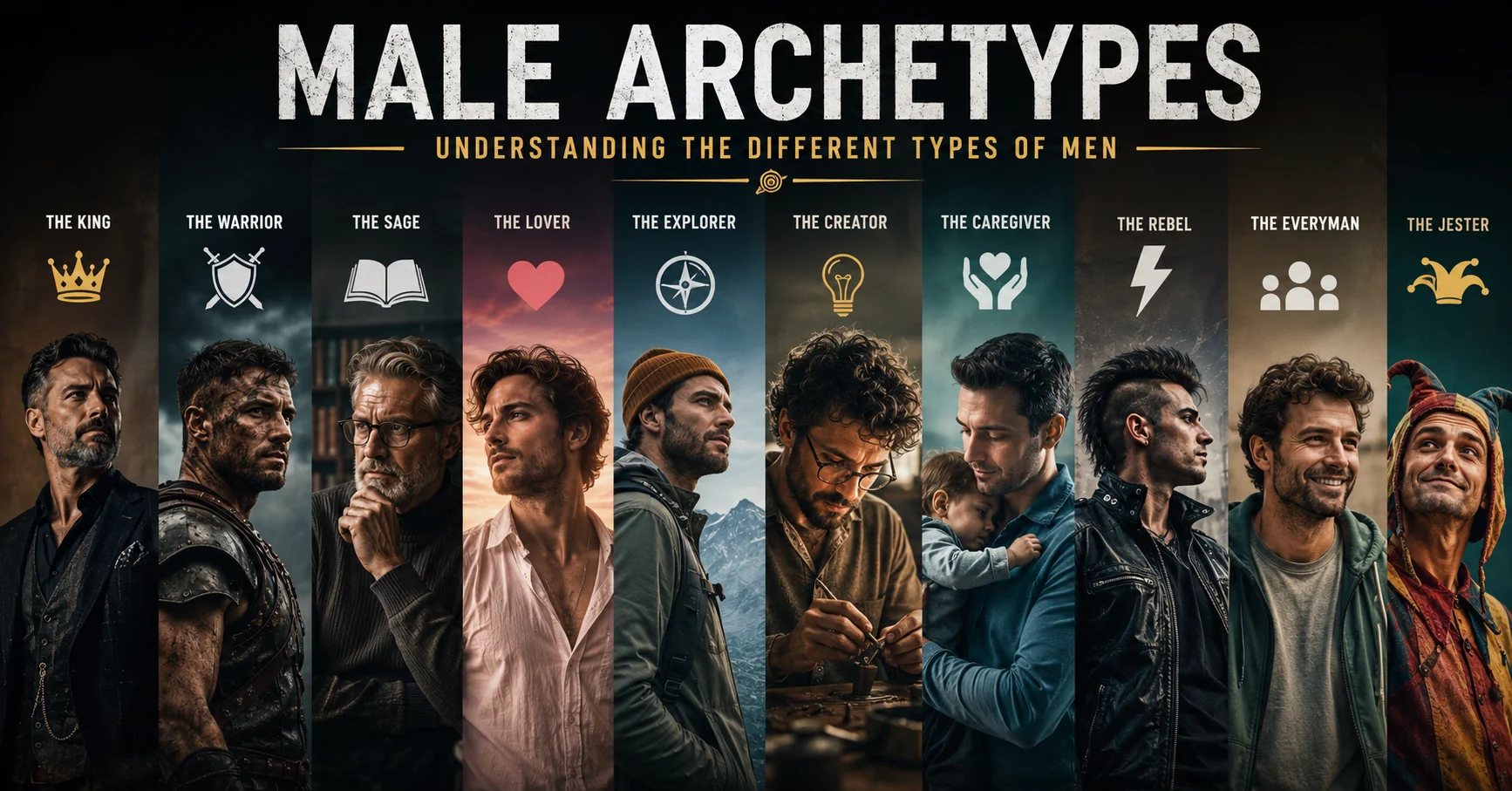
People are complex. No single personality type can explain every man, and trying to put everyone into one box can quickly become limiting. Still, certain patterns of behavior, values, strengths, and challenges appear again and again. These patterns are often described as male archetypes.
Male archetypes are useful because they give us a simple way to explore different approaches to leadership, relationships, ambition, independence, creativity, responsibility, and personal growth. They are not strict personality categories or scientific diagnoses. Instead, they can be viewed as frameworks for understanding recurring masculine patterns.
One man might naturally take on the role of a leader, while another feels most comfortable as a protector, creator, thinker, explorer, or supportive friend. Someone may even move between several Male Archetypes depending on his age, environment, relationships, and life experiences.
Understanding these different types of men can help people recognize their own strengths, identify unhealthy patterns, and develop a more balanced sense of identity.
ALSO READ: Client Case Aelftech com: A Simple Overview
What Are Male Archetypes?
Male archetypes are symbolic personality patterns that describe common ways men may think, behave, relate to others, and approach life.
The idea of Male Archetypes has roots in psychology and mythology, particularly in the work associated with Carl Jung. Male Archetypes were used to describe recurring human patterns that appear across cultures and stories. Over time, different writers and psychologists developed frameworks for understanding masculine behavior through archetypal roles.
A male archetype should not be treated as a permanent label.
For example, a man who is naturally ambitious may display strong leadership qualities at work but become gentle and nurturing with his family. Another man may be adventurous in his personal life but cautious when making financial decisions.
This is why Male Archetypes are better understood as patterns rather than boxes.
They can help answer questions such as:
- What motivates a person?
- How does he handle responsibility?
- How does he respond to conflict?
- What does he value?
- How does he build relationships?
- What happens when he is under pressure?
- What strengths does he naturally rely on?
- What weaknesses might he need to work on?
The goal is not to decide which archetype is “best.” The goal is to understand how different qualities can work together.
Why Understanding Male Archetypes Matters
Modern discussions about masculinity can sometimes become confusing. Men receive different messages about what they are supposed to be, how they should behave, and what qualities they should display.
One message may encourage toughness and independence. Another may emphasize emotional openness and vulnerability. Both can contain useful ideas, but neither tells the whole story.
Understanding male archetypes creates a broader perspective.
A healthy man does not necessarily need to be dominant, aggressive, wealthy, physically strong, or emotionally distant. Strength can also appear as patience, self-control, compassion, courage, responsibility, creativity, or the willingness to admit mistakes.
Male Archetypes help demonstrate that masculinity can take many forms.
They can also be useful in relationships. When people recognize that different men may have different emotional and behavioral styles, they may become better at communication and less likely to interpret every difference as a personal problem.
Most importantly, Male Archetypes can encourage self-reflection.
Instead of asking, “What kind of man am I supposed to be?” a better question may be, “Which qualities do I want to develop?”
The King: The Natural Leader
The King archetype represents leadership, responsibility, stability, and direction.
A healthy King does not lead simply because he wants power. He understands that leadership comes with responsibility. He tries to create stability for himself and the people around him.
This type of man often enjoys making decisions, organizing people, setting goals, and creating a sense of order. He may naturally become the person others turn to when something needs to be handled.
Strengths of the King
A balanced King can be:
- Responsible
- Confident
- Decisive
- Fair
- Protective
- Organized
- Vision-oriented
- Comfortable with accountability
He does not need constant praise to feel valuable. His confidence comes from knowing that he can handle responsibility.
The Shadow Side of the King
Every archetype has an unhealthy version.
The unhealthy King may become controlling, arrogant, demanding, or obsessed with status. Instead of leading people, he may try to dominate them.
A man can move from healthy leadership to unhealthy control when he begins believing that being respected means always getting his way.
The lesson for this archetype is simple: true leadership creates trust rather than fear.
The Warrior: The Man Of Action
The Warrior archetype represents courage, discipline, determination, and action.
This is the man who sees a difficult situation and thinks, What needs to be done?
He tends to value preparation, persistence, and practical results. He may enjoy sports, challenging careers, physical activities, competition, or situations that require resilience.
The Warrior does not necessarily have to be aggressive. At his healthiest, he is disciplined rather than violent and courageous rather than reckless.
Strengths of the Warrior
A healthy Warrior often demonstrates:
- Determination
- Courage
- Discipline
- Persistence
- Focus
- Physical and mental resilience
- Willingness to face challenges
He understands that meaningful goals often require effort.
The Shadow Side of the Warrior
An unhealthy Warrior can become unnecessarily confrontational.
He may treat every disagreement like a battle, struggle to relax, or believe that showing vulnerability is weakness. He might also become overly competitive and measure his worth through victories.
The Warrior’s growth comes from learning that not every situation needs to be conquered.
Sometimes strength means knowing when to fight, when to negotiate, and when to walk away.
The Sage: The Thinker And Observer
The Sage archetype is associated with knowledge, curiosity, reflection, and understanding.
This man often wants to know why things happen. He may enjoy reading, studying, researching, analyzing problems, or having deep conversations.
Rather than immediately reacting, the Sage tends to step back and observe.
Strengths of the Sage
The healthy Sage can be:
- Thoughtful
- Curious
- Analytical
- Wise
- Patient
- Open-minded
- Intellectually independent
He often helps others see situations from a different perspective.
The Shadow Side of the Sage
The Sage can become trapped in his own thoughts.
An unhealthy version may overanalyze everything, avoid emotional experiences, or use knowledge as a way to feel superior.
He may spend so much time thinking about life that he forgets to actually live it.
The Sage grows when he learns to balance knowledge with experience.
The Lover: The Emotionally Connected Man
The Lover archetype represents connection, passion, affection, appreciation, and emotional awareness.
This type of man may value relationships deeply. He notices beauty, enjoys meaningful experiences, and often wants to create strong emotional bonds with the people he cares about.
The Lover reminds us that masculinity does not have to exclude tenderness.
Strengths of the Lover
A healthy Lover may be:
- Affectionate
- Empathetic
- Passionate
- Emotionally aware
- Romantic
- Creative
- Appreciative
- Deeply connected to others
He can often recognize emotions that other people overlook.
The Shadow Side of the Lover
An unhealthy Lover may become emotionally dependent, jealous, possessive, or overly focused on receiving affection.
He may struggle when relationships change or end because so much of his identity is tied to emotional connection.
His growth involves learning that intimacy and independence can exist together.
The Explorer: The Independent Adventurer
The Explorer archetype represents freedom, curiosity, independence, and discovery.
An Explorer wants to experience life rather than simply follow a predetermined path.
He may enjoy travel, entrepreneurship, outdoor activities, new hobbies, unusual ideas, or unfamiliar environments. Routine can sometimes feel restrictive to him.
Strengths of the Explorer
A healthy Explorer is often:
- Independent
- Curious
- Adventurous
- Flexible
- Open to change
- Courageous
- Comfortable with uncertainty
He encourages people to question assumptions and experience new possibilities.
The Shadow Side of the Explorer
Too much independence can become isolation.
The unhealthy Explorer may avoid commitment, constantly chase the next exciting experience, or leave situations whenever they become difficult.
Freedom is valuable, but meaningful relationships and responsibilities also require consistency.
The Explorer becomes stronger when he learns that commitment does not automatically mean losing freedom.
The Creator: The Man Who Builds
The Creator archetype is driven by imagination, expression, and the desire to make something meaningful.
He may be an artist, designer, writer, musician, entrepreneur, engineer, craftsman, or simply someone who enjoys developing ideas.
The Creator often looks at ordinary things and imagines what they could become.
Strengths of the Creator
The healthy Creator can be:
- Imaginative
- Innovative
- Passionate
- Original
- Persistent
- Expressive
- Problem-solving oriented
He brings new possibilities into the world.
The Shadow Side of the Creator
Creators can become overly attached to perfection.
They may procrastinate because their work does not match the ideal image in their head. Some may also become frustrated when others do not understand their vision.
The Creator’s growth comes from accepting that finished work is often more valuable than perfect ideas that never become reality.
The Caregiver: The Supportive Man
The Caregiver archetype represents compassion, service, responsibility, and protection.
This man often feels fulfilled when he can help others. He may be the dependable friend, supportive partner, dedicated father, helpful colleague, or person everyone calls during difficult times.
His strength is often quiet rather than dramatic.
Strengths of the Caregiver
A healthy Caregiver may demonstrate:
- Compassion
- Patience
- Loyalty
- Generosity
- Reliability
- Emotional support
- Responsibility
He understands that being strong can mean showing up for someone consistently.
The Shadow Side of the Caregiver
The biggest danger is self-neglect.
A Caregiver may become so focused on helping others that he ignores his own needs. He may also become resentful when people take his generosity for granted.
Healthy caregiving requires boundaries.
Helping others should not mean abandoning yourself.
The Rebel: The Challenger Of Rules
The Rebel archetype questions established systems and traditions.
He may dislike unnecessary rules and feel uncomfortable with authority that cannot justify itself. He often notices contradictions and is willing to challenge conventional thinking.
The Rebel can be an important force for change.
Strengths of the Rebel
A healthy Rebel is often:
- Independent-minded
- Courageous
- Honest
- Creative
- Questioning
- Unafraid of disagreement
He can help people recognize when old assumptions no longer make sense.
The Shadow Side of the Rebel
Rebellion for its own sake can become destructive.
An unhealthy Rebel may reject useful advice simply because it comes from authority. He may create conflict unnecessarily or confuse being different with being correct.
The mature Rebel learns to question rules intelligently rather than automatically rejecting everything.
The Everyman: The Grounded And Relatable Man
Not every man wants to be extraordinary.
The Everyman archetype represents authenticity, belonging, humility, and everyday connection. He values friendship, family, community, and being accepted for who he is.
He may not seek the spotlight, but he can provide stability and genuine companionship.
Strengths of the Everyman
A healthy Everyman can be:
- Loyal
- Approachable
- Humble
- Practical
- Reliable
- Friendly
- Authentic
He reminds us that a meaningful life does not have to look impressive from the outside.
The Shadow Side of the Everyman
The downside can be excessive conformity.
A man may become so concerned with fitting in that he stops pursuing his own interests or expressing his true opinions.
His growth involves developing individuality while maintaining meaningful relationships.
The Jester: The Man Who Brings Lightness
The Jester archetype uses humor, playfulness, and spontaneity to connect with people.
He can make difficult situations feel lighter and often notices the absurd side of everyday life.
Humor can be a powerful social skill.
Strengths of the Jester
A healthy Jester may be:
- Funny
- Adaptable
- Social
- Playful
- Creative
- Optimistic
- Good at reducing tension
He can help people relax and connect.
The Shadow Side of the Jester
Humor can also become a hiding place.
An unhealthy Jester may use jokes to avoid serious conversations, hide insecurity, or make light of someone else’s pain.
Maturity means knowing when to laugh and when to listen.
Can One Man Have Multiple Male Archetypes?
Absolutely.
This is one of the most important things to understand about male archetypes.
A person rarely fits perfectly into one category.
A man could be a Warrior at work, a Lover in his relationship, a Sage when solving problems, and a Caregiver with his family.
These qualities can also change over time.
A young man may strongly identify with the Explorer because he wants freedom and new experiences. Later, becoming a parent or building a career might strengthen his Caregiver or King qualities.
Life experiences can reshape which traits become dominant.
This is why Male Archetypes should be used as tools for reflection rather than rigid personality tests.
Healthy Masculinity Is About Balance
The healthiest approach is not choosing one archetype and rejecting the others.
Balance is usually more valuable.
A strong leader benefits from empathy. A Warrior benefits from patience. A Sage benefits from action. An Explorer benefits from commitment. A Lover benefits from boundaries. A Caregiver benefits from self-care.
In other words, the goal is not to become “more masculine” by exaggerating one characteristic.
The goal is to develop a well-rounded character.
A man can be confident without being arrogant.
He can be emotionally open without losing strength.
He can be independent while maintaining close relationships.
He can be ambitious without measuring his entire worth through success.
He can be protective without becoming controlling.
These combinations create a much healthier picture of masculinity.
How To Identify Your Dominant Male Archetypes
If you want to understand your own archetypal patterns, start by examining your everyday behavior.
Ask yourself:
What motivates me?
Do you feel most energized by achievement, knowledge, freedom, relationships, creativity, service, or leadership?
Your strongest motivation can reveal an important part of your personality.
How do I handle pressure?
When life becomes difficult, do you take action, analyze the situation, seek support, make jokes, withdraw, or try to control everything?
Your response to pressure can reveal your strongest and weakest patterns.
What do people come to me for?
Friends may seek one person for advice, another for emotional support, and another when they need someone to take charge.
The role you naturally play in other people’s lives can provide useful clues.
What weakness keeps repeating?
Male Archetypes are not only about strengths.
If you are naturally independent, do you avoid commitment?
If you are a leader, do you become controlling?
If you are intellectual, do you overthink?
If you are caring, do you neglect yourself?
Understanding the shadow side can be more valuable than simply identifying your strengths.
Male Archetypes And Relationships
Understanding Male Archetypes can also improve relationships.
Two people may genuinely care about each other while having very different ways of expressing that care.
For example, a Caregiver may show love through practical support, while a Lover may express it through affection and emotional conversation.
An Explorer may need personal space, while an Everyman may place greater importance on shared routines.
Neither approach is automatically wrong.
Problems often appear when people assume their preferred style is the only acceptable one.
Recognizing different patterns can encourage better communication.
Instead of saying, “You don’t care about me,” someone might explain what behavior would make them feel supported.
Instead of assuming that a need for independence means rejection, a partner can ask what personal space actually means to the other person.
Male Archetypes can provide a useful language for these conversations.
The Danger Of Stereotyping Men
There is an important distinction between understanding Male Archetypes and stereotyping.
Stereotypes say, “Men of this type always behave this way.”
Male Archetypes say, “This pattern may help us understand certain behaviors.”
That difference matters.
Not every man wants to lead. Not every man enjoys competition. Not every man is emotionally reserved. Not every man wants adventure. Not every man values traditional ideas about masculinity.
Individual personality, culture, family experiences, education, relationships, and personal choices all matter.
Male Archetypes should expand our understanding of men, not reduce it.
Using Archetypes For Personal Growth
The most useful reason to study male archetypes is personal development.
Once you understand your natural tendencies, you can ask what qualities you might need to strengthen.
A highly independent man might benefit from practicing vulnerability.
A naturally emotional man might benefit from developing stronger boundaries.
A highly ambitious man might need to make more room for relationships and rest.
A thoughtful man might need to take action instead of endlessly analyzing possibilities.
A natural caregiver might need to learn how to say no.
Growth often happens when we develop qualities that do not come naturally.
You do not have to abandon your strongest archetype. Instead, you can complement it with other qualities.
Final Thoughts
Male archetypes offer an interesting way to understand the many forms masculinity can take. From the King and Warrior to the Sage, Lover, Explorer, Creator, Caregiver, Rebel, Everyman, and Jester, each archetype represents a different collection of strengths, motivations, and potential challenges.
No archetype is inherently better than another.
The confident leader needs compassion. The thinker needs action. The adventurer needs grounding. The caregiver needs boundaries. The romantic needs independence. The rebel needs wisdom.
The healthiest approach is to recognize your natural tendencies while remaining open to growth.
Ultimately, understanding male archetypes is less about putting men into categories and more about understanding the different qualities that can exist within one person. A man can lead without controlling, protect without dominating, love without losing himself, and pursue ambition without sacrificing his humanity.
The real goal is not to discover one perfect archetype.
It is to become a more balanced, self-aware, responsible, and authentic version of yourself.
FAQs
What is a Male Archetypes?
A male archetype is a symbolic pattern used to describe common masculine traits, behaviors, motivations, and roles.
How many male archetypes are there?
There is no single official number. Different psychological and personal-development systems use different Male Archetypes and classifications.
Can a man have more than one archetype?
Yes. Most people display characteristics from several archetypes, with different traits becoming stronger in different situations.
Are male archetypes scientifically proven personality types?
Not exactly. Archetypes are best viewed as psychological and symbolic frameworks for reflection rather than strict scientific personality categories.
Why are male archetypes useful?
They can help people understand personality patterns, strengths, weaknesses, relationships, emotional habits, and areas for personal growth.
ALSO READ: Concepting: Turning Ideas Into Creative Solutions

Emily Carter is a tech enthusiast who writes about PC cooling, hardware performance, and system optimization. She enjoys simplifying complex topics and helping readers make better tech decisions.